
Events and Timeboxing - Learn Scrum

Scrum Framework Library - Events and Timeboxing

What is timeboxing and why is it important in Scrum?

Timeboxing is a technique that sets fixed time durations for meetings and activities in Scrum. It is important in Scrum because it helps create a sense of urgency, promotes focus, ensures regular cadence, and fosters effective time management.

Timeboxing is a technique used in Scrum to allocate fixed time durations for meetings, activities, and events. It involves setting specific time boundaries and adhering to them strictly.
Timeboxing is important in Scrum for several reasons:
- Sense of urgency: By having fixed time constraints, timeboxing creates a sense of urgency and encourages the Scrum Team to focus on completing the work within the given time frame.
- Focus and productivity: Timeboxing promotes focus by defining clear time boundaries for activities. It helps prevent unnecessary discussions, digressions, or over-analysis, leading to increased productivity.
- Regular cadence: Timeboxing ensures a regular cadence of events and activities in Scrum. For example, Sprints have fixed time durations, and other meetings such as Daily Scrum, Sprint Planning, Sprint Review, and Sprint Retrospective have timeboxed durations. This regular cadence enables predictability, planning, and synchronization within the team.
- Effective time management: Timeboxing encourages effective time management by setting limits on how much time can be spent on a particular activity. It helps teams allocate time appropriately to different tasks and ensures that meetings and events do not exceed their designated durations.

Overall, timeboxing is a valuable practice in Scrum as it supports discipline, focus, and effective time management, ultimately contributing to the team's productivity and success.

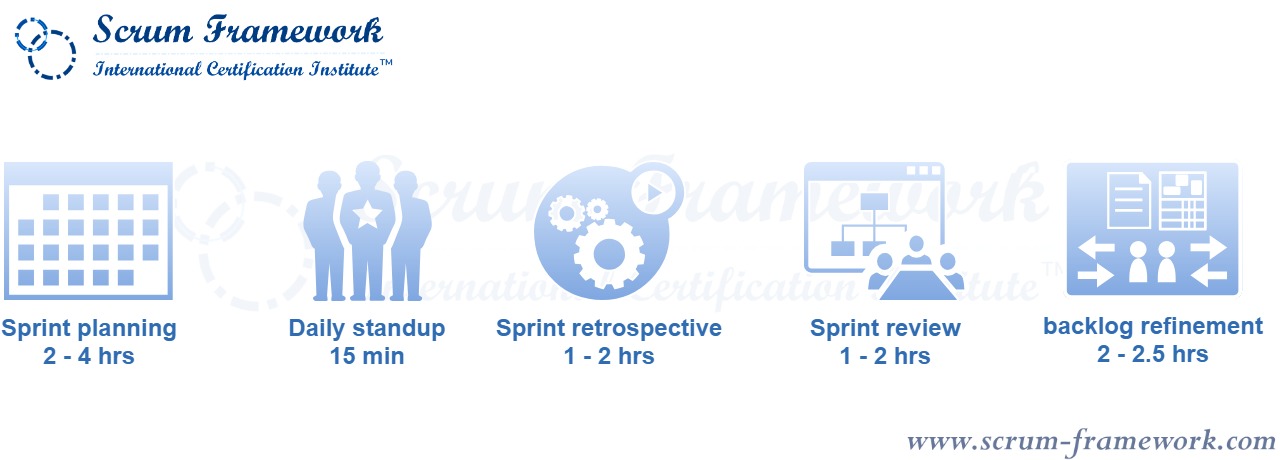
The Sprint Planning meeting should typically last for a maximum of eight hours per month of Sprint duration. For example, for a two-week Sprint, the duration should not exceed four hours.

The duration of the Sprint Planning meeting in Scrum depends on the length of the Sprint. As a guideline, the meeting should last a maximum of eight hours per month of Sprint duration. This means that for a two-week (14-day) Sprint, the Sprint Planning meeting should not exceed four hours. For a one-month (30-day) Sprint, the meeting should be completed within eight hours.

The time allocated for Sprint Planning should be used judiciously to achieve the meeting's objectives, which include defining the Sprint Goal, selecting Product Backlog items to work on, and creating a plan for the Sprint. The Scrum Team should ensure that the meeting is focused, collaborative, and results in a shared understanding of the work to be done during the Sprint.

The recommended duration for the Daily Scrum is 15 minutes.

The Daily Scrum, also known as the daily stand-up, is a timeboxed event in Scrum. The recommended duration for the Daily Scrum is 15 minutes. The purpose of the Daily Scrum is to enable the Development Team to synchronize their activities, plan for the day, and identify any impediments.

During the Daily Scrum, each Development Team member provides a brief update on the progress made since the last Daily Scrum, discusses what they plan to work on next, and highlights any challenges or impediments that may require assistance. The time constraint of 15 minutes ensures that the meeting remains focused and efficient, allowing the team to quickly align their efforts without delving into detailed discussions or problem-solving.

The Sprint Review and Sprint Retrospective should typically last for a maximum of three hours for a one-month Sprint. For shorter Sprints, the duration should be adjusted accordingly.

The duration of the Sprint Review and Sprint Retrospective in Scrum can vary depending on the length of the Sprint and the size of the Scrum Team. As a general guideline, these meetings should typically last a maximum of three hours for a one-month (30-day) Sprint.

For shorter Sprints, the duration should be adjusted proportionately. For example, for a two-week (14-day) Sprint, the duration of the Sprint Review and Sprint Retrospective should be kept within 1.5 hours.

It is important to ensure that sufficient time is allocated for meaningful discussions, feedback, and collaborative activities during these meetings. However, it is equally important to maintain focus, adhere to the timebox, and avoid unnecessary delays or tangents to ensure the Scrum events remain efficient and productive.

Challenges that can arise when working within timeboxes include insufficient time for discussions, difficulties in managing scope, and potential conflicts with stakeholders. These challenges can be addressed by promoting effective facilitation, prioritization, and open communication.

When workingwithin timeboxes in Scrum, several challenges can arise.
Here are some common challenges and ways to address them:
1. Insufficient time for discussions: Timeboxing can sometimes limit the amount of time available for in-depth discussions, analysis, or problem-solving. To address this, it's important to encourage effective facilitation during meetings. The facilitator can help keep discussions focused, prioritize topics, and ensure that the team stays on track. If a topic requires more time than allocated, it can be scheduled for a separate discussion outside the timebox.
2. Difficulties in managing scope: Timeboxing helps manage scope by setting fixed time durations for activities. However, it can be challenging to fit all planned work within the timebox. To address this, the Product Owner and the Development Team should collaborate closely to prioritize the most valuable items and determine what can realistically be accomplished within the given time. If necessary, items can be deferred to future iterations or reprioritized based on changing circumstances.
3. Potential conflicts with stakeholders: Timeboxing may lead to conflicts with stakeholders who have different expectations or time constraints. It's important to establish clear communication channels with stakeholders and manage their expectations effectively. Regular updates, feedback sessions, and involvement in Sprint Reviews can help address concerns and align expectations. If conflicts arise, they should be addressed promptly through open and transparent communication.
4. Inflexibility and resistance to change: Some team members or stakeholders may resist the strict time constraints imposed by timeboxing. They might be reluctant to adapt or feel constrained by the fixed durations. It's crucial to emphasize the benefits of timeboxing, such as improved focus, productivity, and predictability. Encouraging a culture of continuous improvement and flexibility can help overcome resistance to change. Regularly reviewing and adjusting the timeboxes based on feedback and lessons learned can also promote a sense of ownership and engagement.
5. Inadequate preparation or follow-up: Timeboxing requires effective planning and preparation to make the most of the allocated time. Insufficient preparation can lead to wasted time or unproductive meetings. Similarly, inadequate follow-up after a timeboxed activity may result in unresolved issues or missed opportunities for improvement. To address these challenges, it's important to emphasize the importance of preparation and follow-up within the team. Clear agendas, defined objectives, and action items can help ensure that timeboxed activities are well-structured and yield valuable outcomes.

By being aware of these challenges and implementing appropriate strategies, teams can mitigate the potential drawbacks of timeboxing and maximize the benefits it offers in terms of focus, efficiency, and effective time management.